Universe
Universe is everything. It includes all the space, and all the matter and energy that space contains. It even includes time itself.
- Smallest atom to the largest galaxy is part of it
- It is measured using Light Year(ly)
- The observable universe is 93 billion light-years (about meters)
🚀 Voyager 1: Earth's Farthest Emissary
Launched by NASA on September 5, 1977, Voyager 1 is the most distant human-made object in existence. In 2012, it made history by becoming the first spacecraft to enter interstellar space (the space between stars).
- Primary Mission: Explored Jupiter and Saturn, revealing active volcanoes on Io and the thick atmosphere of Titan.
- The Golden Record: Carries a copper phonograph record filled with Earth’s sounds, images, and greetings for potential alien life.
- Pale Blue Dot: Captured the iconic photograph of Earth from 6 billion kilometres away in 1990.
- Status: Still transmitting data back to Earth from over 24 billion kilometres away, using its aging nuclear power source.
Different Branches of Science for the Study of Universe
- Cosmology: Whole universe (origin & future)
- Astronomy: Starts, Planets, Galaxies
- Astrophysics: Physics of Celestial bodies
- Astro-biology: Life in the universe
- Planetary Science: Planets and Stars
- Exoplanetology: Worlds beyond the Solar system.
Important Terms for understanding Universe
- 🔗Various units for Measuring Astronomical Distances (ly, AU, PC)
- Aphelion: The point when a celestial body is farthest from Sun. For earth it’s 152.5 million km around 4th July
- Perihelion: The point when a celestial body is closest to Sun. For earth it’s 147.5 million km around 3rd January.
- Equinox: These are the times of year when the Earth’s axis is tilted neither towards nor away from the sun, resulting in equal day and night hours.
- Solstice: These are the times of year when the Earth’s axis is tilted most towards or away from the sun, marking the start of summer or winter.
Philosophical Hypotheses regarding the Creation of the Universe
Monistic
- Core Concept: The universe originated from a single, unified substance, energy, or ultimate reality.
- Scientific Parallel: The Big Bang Singularity, where all matter, energy, space, and time existed as a single point.
- Philosophical Example: Spinoza’s Pantheism, which views God and the physical universe as one identical substance.
Dualistic
- Core Concept: The universe was created through the interaction or conflict of two independent, co-eternal forces.
- Scientific Parallel: Matter and Antimatter, or the fundamental interaction between space-time geometry and mass-energy.
- Philosophical Example: Zoroastrianism, which attributes creation to the opposing forces of supreme light and absolute darkness.
The Big Bang Theory (BBT)
Core Concepts & Timeline
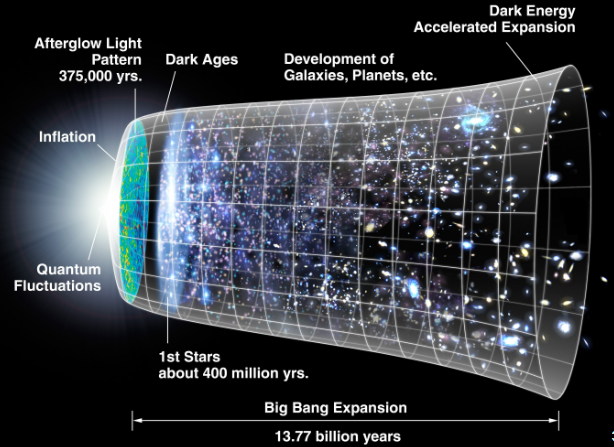
- Origin: The universe originated from a tremendous explosion that occurred about 13.7 billion years ago. Meaning Temperature, Density, Energy condensed into a tiny point.
- The Singularity: At the very beginning, all matter and energy were concentrated at a single tiny point.
- Expansion Dynamics: The expansion of the universe continues to this day.
- Rate of Expansion: The expansion rate was *high* in the beginning and is comparatively *low today*.
- First Atoms: Formed within 3 minutes of the initial expansion.
- Atomic Matter: Within 3 lakh (300,000) years, the temperature dropped to 4,500 K (Kelvin), giving rise to atomic matter.
- Macro Structure: Subsequent condensation took place, leading to the formation of stars and planets.
Historical Context
- Georges Lemaître: Propounded the theory in 1927; it gained widespread acceptance in 1931.
- Edwin Hubble: Provided critical empirical evidence supporting cosmic expansion in 1929.
Thermodynamic Principles
- Temperature-Volume Relation: Governed by the physics principle where .
- Cosmic Cooling: As the universe expands, its volume increases, causing the overall temperature to reduce.
Cosmic Microwave Background Radiation (CMBR) Evidence
- First detected & proved in 1965 by Arno Penzias and Robert Wilson.
- It is the relic radiation from the recombination era.
- Nobel Prize: Arno Penzias and Robert Wilson were awarded the Nobel Prize for this discovery.
🔭 Expanding Universe and Cosmological Shift
- Redshift: Observed when celestial bodies are moving away from us. The redshift observed in distant galaxies is primarily interpreted as evidence of the expansion of the universe.
- Blueshift: Observed when celestial bodies are moving closer to us.
🍰 Universe Composition
The universe’s matter and energy are divided into:
- Dark Energy: 68.3%
- Dark Matter: 26.8%
- Atoms (Normal Matter): 4.9%
🌌 Galaxies
A galaxy is made up of millions or billions of stars and planets held together by gravity.
- Types of Galaxies: They are broadly categorised as Elliptical, Spiral, and Irregular.
- The Milky Way: Our home galaxy takes the form of a spiral and contains the planet Earth.
- Its radius is 50,000 light-years.
- Sagittarius A* is a massive black hole present in the centre of our galaxy.
- Andromeda: A spiral galaxy that is the closest galaxy to our own.
⭐ Stars: Birth, Evolution, and Death
Stars are the building blocks of our Galaxy. The raw material for their formation is mainly hydrogen gas and some helium gas.
- Nebula: An enormous cloud of dust and gas occupying the space between stars, acting as a nursery for new stars.
- Formation: Stars are formed by the gravitational collapse of these over-dense clouds of gases. This collapse triggers nuclear fusion (conversion of Hydrogen into Helium, releasing massive radiation).
- Observation Facts: - The twinkling of a star is due to the atmospheric refraction of starlight.
- Sirius A (Dog Star) is the brightest star in our solar system’s vicinity.
Exam Focus
Pay close attention to the specific percentages of universe composition and the cause of a star’s twinkling. These are classic, high-yield facts for National Defence Academy entrance exams.
Life Cycle Paths
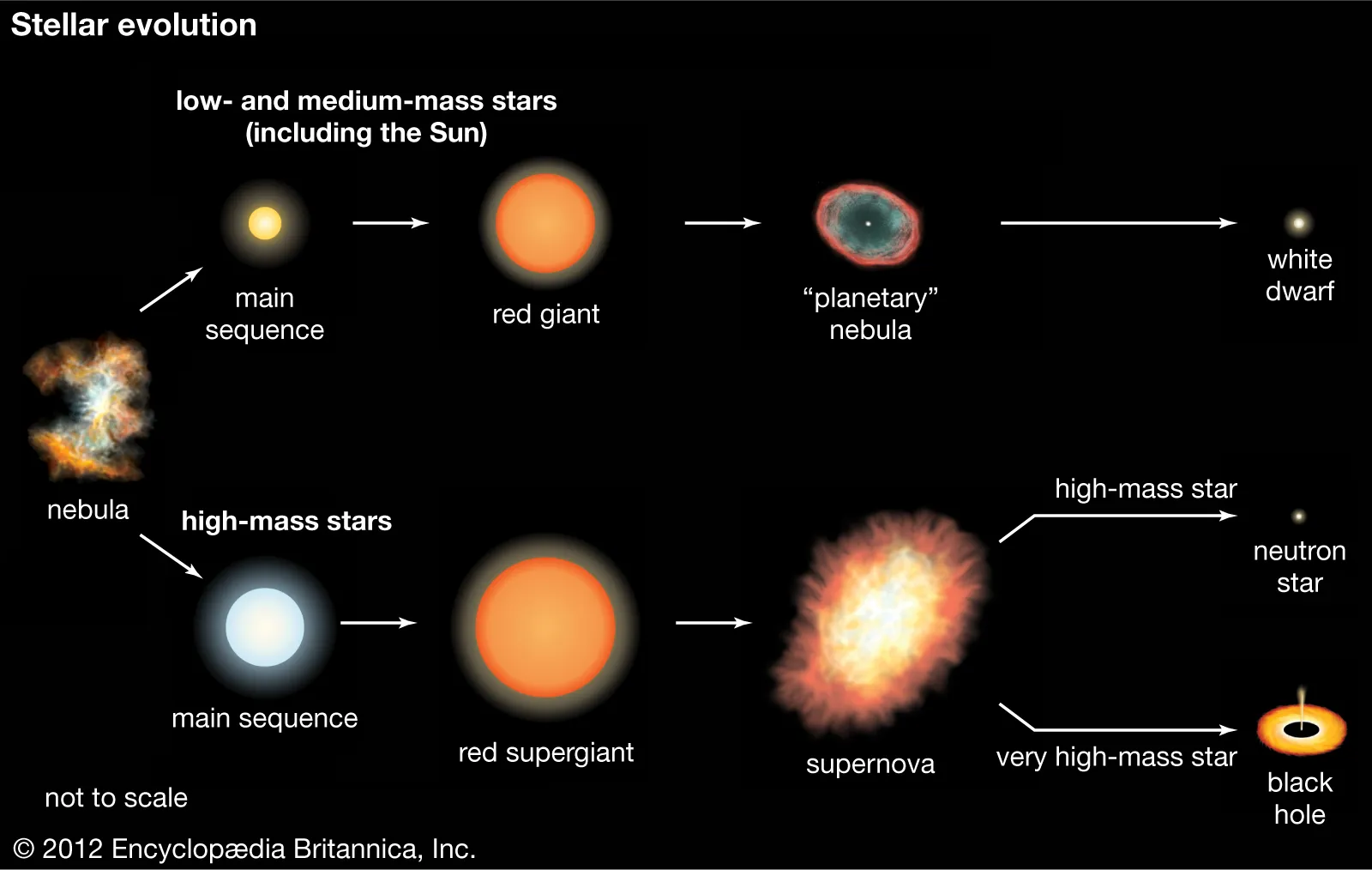
The evolutionary path of a star is determined by its mass, with the Chandrasekhar limit (1.44 Solar Masses) acting as a crucial threshold.
- Small/Medium Stars (Mass < 1.44): Dust + Gas -> Protostar -> Main Sequence Star (like our Sun) -> Red Giant -> White Dwarf -> Black Dwarf (Death).
- Massive Stars (Mass > 1.44): Dust + Gas -> Protostar -> Main Sequence Star -> Super Red Giant -> Supernova Blast -> Neutron Star OR Black Hole.
🕳️ Black Holes
- A black hole is a region in space where gravity is so strong that nothing, not even light, can escape.
- They are formed from the remnants of massive stars after they collapse into themselves under their own gravity.
- Due to this collapse, a black hole has a large acceleration due to gravity on its surface.
- Event Horizon: The boundary around a black hole from which nothing can escape.