Motion in 1D (Kinematics)
Fundamentals of Motion
Dimensionality of Motion
- One-Dimensional (1D) Motion: Motion along a straight line (e.g., purely along the x, y, or z-axis).
- Two-Dimensional (2D) Motion: Motion within a plane (e.g., the x-y plane). Examples include projectile motion and circular motion.
- Three-Dimensional (3D) Motion: Motion in space requiring all three coordinates (x, y, z) to specify position (e.g., a flying bird or a gas molecule).
Rest, Motion, and Reference Frames
- Rest and Motion are Relative: An object can be at rest relative to one observer but in motion relative to another. For example, passengers in a moving train are at rest relative to each other but in motion relative to a person standing on the platform.
- Reference Frame: The coordinate system (and observer) from which the position and time of events are measured.
The Absolute Truth
> There is no such thing as **absolute rest** or **absolute motion** in the universe. Everything is in motion relative to something else.
Distance and Displacement
Definitions
- Distance (): The actual total path length covered by a moving particle.
- It is a Scalar quantity (only has magnitude).
- Unit: (SI), (CGS).
- Displacement ( or ): The shortest straight-line path directed from the initial position to the final position.
- It is a Vector quantity (has both magnitude and direction).
- Unit: (SI), (CGS).
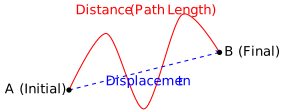
Key Differences
| Feature | Distance | Displacement |
|---|---|---|
| Sign | Always positive () or zero. Can never be negative. | Can be positive (), negative (), or zero. |
| Time Dependence | For a moving body, distance never decreases with time. It only increases or stays constant. | Displacement can increase, decrease, or become zero. |
| Magnitude Relation |
Displacement in Circular Paths
If a particle moves along a circular path of radius and subtends an angle at the center, the displacement between the initial and final points is:

Example
Q1. A particle moves in a semicircle of radius from point A to point B. What are the distance and displacement?
- (Straight across the diameter)
Q2. A particle moves 8m East, 4m North, 4m West, and 1m North. Find distance and displacement.
- .
- Final position relative to start: East, North.
- .
Q3. A pendulum of length swings through an angle of . Find distance and displacement.
- .
- .
Speed and Velocity
Definitions
- Speed: The rate of distance covered with respect to time. (Scalar)
- Velocity: The rate of change of position (displacement) with respect to time. (Vector)
Uniform Speed vs Uniform Velocity
- Uniform Velocity means both magnitude (speed) and direction are constant. The particle must move in a straight line.
- Uniform Speed means only magnitude is constant. A particle can have uniform speed but variable velocity if its direction changes (e.g., uniform circular motion).
Average Values
Average values are calculated over a finite time interval .
- Average Speed:
- Average Velocity:
- Note: The formula is only valid for motion with constant acceleration.
Example
Q1. A train travels from station A to B at and returns from B to A at . Find its average speed and average velocity.
- Since initial and final positions are the same (A), .
- Let distance A to B be . Total distance = .
- Total time = .
- .
Relations between Speed and Velocity
- Signs: Speed is always positive or zero (). Velocity can be negative depending on direction.
- Uniformity: Uniform Velocity guarantees Uniform Speed, but the reverse is only true for straight-line motion.
- Zero Averages: If , then must be . But if , can still be non-zero (e.g., returning to start).
- Instantaneous vs Average:
- Instantaneous: Magnitude of instantaneous velocity always equals instantaneous speed ().
- Average: Magnitude of average velocity average speed (). They are equal only in straight-line, one-way motion.
Calculus in Kinematics
When position, velocity, or acceleration are given as continuous functions of time (), we use differentiation and integration to analyze the motion.
Instantaneous Values (Differentiation)
Instantaneous values are calculated at a specific, exact instant in time (where ).
- Instantaneous Velocity (FYI just ts works for speed too):
- Instantaneous Acceleration:
- Chain Rule for Acceleration:
Finding Averages via Integration
When velocity is a function of time , displacement is the integral of velocity. When velocity is a function of position , it’ll be same, just replace the with in the below equations.
- Displacement:
- Average Velocity:
Example
Q1. A particle’s position is given by . Find the average velocity between and , and the instantaneous velocity at .
- Average Velocity:
- At , .
- At , .
- .
- Instantaneous Velocity:
- .
- At , .
Q2. If velocity is given by , find the average velocity for the interval .
- Integral = .
- .
Q3. The instantaneous velocity is given by . Find the distance travelled between and . (Assume 1D motion without turning).
- Distance =
- .
Q4. The position of a particle as a function of time is given by , where and are constants. When the particle attains zero acceleration, what will its velocity be?
- Velocity:
- Acceleration:
- For zero acceleration:
- Substitute into the velocity equation:
Graphical Analysis of Motion
Slope of Graphs
- Position-Time () Graph: The slope (or gradient) gives the Velocity.
- Constant slope = Constant velocity.
- Zero slope = Body is at rest.
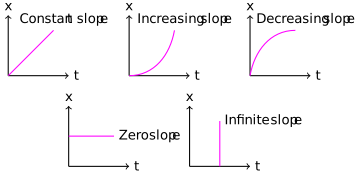
- Velocity-Time () Graph: The slope gives the Acceleration.
- Positive slope = Increasing velocity (positive acceleration).
- Negative slope = Decreasing velocity (retardation/deceleration).
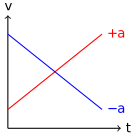
- Acceleration-Time () Graph: The slope gives the Jerk (rate of change of acceleration).
Area Under Graphs
- Velocity-Time () Graph: The area under the curve gives the Displacement (if proper signs are considered) and Distance (if only magnitudes/absolute areas are summed).
- Note: Area above the time axis is taken as positive, area below is negative for displacement. For distance, all areas are added positively.
- Acceleration-Time () Graph: The area under the curve gives the Change in Velocity ().
Example
Q1. The plot of a moving object during the first is a triangle above the axis (height , base ) and a symmetric triangle below the axis (depth , base from to ). Find the average velocity.
- .
Q2. The position, velocity, and acceleration of a particle moving with a constant acceleration can be represented by:
- Since , the graph is a horizontal straight line.
- , so the graph is a straight line with a constant slope.
- , so the graph is a parabola.
Q3. If a velocity-time graph has a V-shape (shape AMB, where AM has a negative slope and MB has a positive slope), what is the shape of the acceleration-time graph?
- Path AM: Constant negative slope constant negative acceleration.
- Path MB: Constant positive slope constant positive acceleration.
- Result: A step function showing a constant negative value followed instantly by a constant positive value.
Equations of Motion (Constant Acceleration)
When the acceleration of a particle is constant (uniform), the following kinematic equations directly relate initial velocity (), final velocity (), acceleration (), displacement (), and time ().
The Standard Equations
- Velocity-Time Relation:
- Position-Time Relation:
- Velocity-Position Relation:
Note: Use for acceleration (velocity increasing) and for retardation (velocity decreasing).
Displacement in the second
The displacement covered specifically during the second of motion (from to ) is given by:
Example
Q1. A particle starts with initial velocity and constant acceleration . Show the derivation of displacement in second.
- Displacement in seconds:
- Displacement in seconds:
- .
Q2. A body starts from rest and moves with constant acceleration. What is the ratio of distance covered in the second to the distance covered in seconds?
- (since )
- Ratio
Q3. A train’s initial velocity is . After travelling with uniform retardation, its velocity becomes . How much further will it travel before coming to rest?
- Let’s find acceleration () first. , , .
- Now, to stop: , ,
- .
Q4. A car moving at stops after by applying brakes. If it moves at , what is the minimum stopping distance?
- (for same constant deceleration)
- If speed doubles (), stopping distance becomes times.
- .
Q5. A particle starts from rest, accelerates at for , goes for a constant speed for , and then decelerates at till it stops. What is the total distance travelled?
- Stage 1 (Acceleration): , , .
- Distance .
- Final velocity .
- Stage 2 (Constant Speed): , .
- Distance .
- Stage 3 (Deceleration): , , .
- .
- Total Distance: .
Q6. A car starting from rest accelerates at rate through a distance , then continues at constant speed for time , and then decelerates at rate to come to rest. If the total distance is , find in terms of and .
- Stage 1: .
- Stage 2: .
- Stage 3: .
- Total Distance:
- .
Q7. Body A starts from rest with acceleration . After , Body B starts from rest with acceleration . If they travel equal distances in the second (after the start of A), what is ?
- Distance by A in its second: .
- Since B starts later, A’s second is B’s second.
- Distance by B in its second: .
- Equating them: .
Q8. A bullet just penetrates a plank. Assuming uniform resistance, what velocity is required to penetrate a plank?
- First, find the retardation ():
- Now for the plank:
- .
Vertical Motion under Gravity
When an object is thrown upwards or dropped, it experiences a constant downward acceleration due to gravity (). The kinematic equations can be directly applied.
Sign Convention
- Upward Direction: Taken as Positive ()
- Downward Direction: Taken as Negative ()
- Acceleration: Always acts downwards, so (or for simpler calculations).
Key Properties (Equations of Vertical Motion)
When an object is thrown vertically upwards with initial velocity from the ground ():
- Speed Symmetry: At the same height level, the speed (magnitude of velocity) of the object is exactly the same while going up and coming down, but the direction is opposite.
- Time Symmetry: The time taken to reach a particular height during ascent is exactly equal to the time taken to fall from that maximum height back to the same level during descent.
- Total Time of Flight (): The total time the object stays in the air.
- Maximum Height (): At the highest point, final velocity .
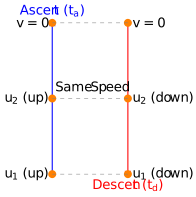
Practice Numericals
Q1. A body is thrown vertically upwards with an initial velocity of . ()
(i) How long will it take to reach the highest point?
(ii) What is the maximum height reached?
(iii) What is the total time to return to the ground?
(iv) At what times will the body be at a height of ?
(v) What will be its velocity after ?
Q2. A stone is dropped from a height of . How much time will it take to cover the last meter?
- Total time to fall :
- Time to fall the first :
- Time for the last meter