Basic Mathematics & Measurements
Angles and Trigonometry
Angle Measurement & Conversion
Definition: An angle (, কোণ) is defined as the ratio of the arc length (, বৃত্ত চাপ) to the radius (, ব্যাসার্ধ), expressed as .
- Units: The primary units are Degrees and Radians.
- Conversions:
- Sub-units of Degrees:
Trigonometric Ratios & Identities
Core Ratios and Values: Based on a right-angled triangle with Perpendicular (), Base (), and Hypotenuse ():
- Pythagorean Identities:
- Additional Formulas:
- Small Angle Approximation ()
When the Angle Is Very Small (Typically less than ), the Trigonometric Functions Simplify Drastically.- CRITICAL: For and , Must Be Converted to Radians for This to Work!
Angles Greater than 90° (ASTC Rule)
-
The quadrant system determines the sign of the trigonometric ratio:
- Quadrant I: All positive.
- Quadrant II: Sin and Cosec positive.
- Quadrant III: Tan and Cot positive.
- Quadrant IV: Cos and Sec positive.
-
When calculating using :
- is the Quadrant number.
- If is even, the function remains the same (e.g., ).
- If is odd, the function changes (e.g., , , ).
Negative Angles
Here and are positive with negative angles, while remain negative.
The 37° / 53° Special Triangle
In a 3-4-5 right-angled triangle, the angle opposite to the side of length 3 is , and the angle opposite to the side of length 4 is . The hypotenuse is always 5. The angles are interchangeable
- For 37° Angle:
- For 53° Angle:
Geometric Progression (GP)
A sequence of numbers where each term after the first is found by multiplying the previous one by a fixed, non-zero number called the Common Ratio ().
- Divergent Series: The terms keep growing (e.g., ) and the sum tends to infinity.
- Convergent Series: The terms get progressively smaller (e.g., ).
- Common Ratio (): .
- Sum of Infinite Convergent Series:
(where is the first term and ).
Example Calculation
Q: Find the sum of the series: (where )
Solution:
Binomial Approximation
When dealing with expansions of powers, we can use a simplified approximation if the second term is extremely small compared to .
- Formula: (Valid strictly when ).
Practical Examples
- .
- .
Coordinate Geometry & Graphs
Slope of a Graph (গ্রাফের নতি)
The slope () measures the steepness and direction of a line.
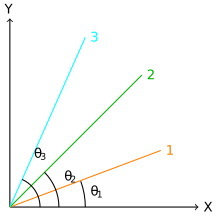
- Formula: .
- Angle Relation: If , then
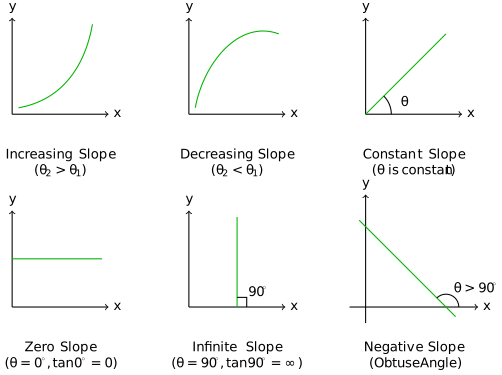
- Types of Slope:
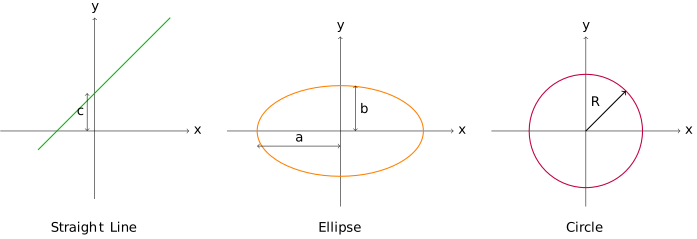
Key 2D Curves
| Curve Type | General Equation | Additional Info |
|---|---|---|
| Straight Line | = slope, = y-intercept. | |
| Ellipse | Area = (where are major/minor semi-axes). | |
| Circle | Area = (Special case of ellipse where ). |
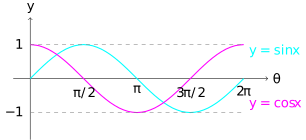
Trigonometric Graphs
- Sine Curve (): Starts at origin , reaches peak at , crosses zero at , trough at , and completes cycle at .
- Cosine Curve (): Starts at peak at , crosses zero at , trough at , crosses zero at , and completes cycle at .
Calculus: Differentiation (অবকলন)
Differentiation represents the rate of change of one physical quantity with respect to another.
- Velocity: (Rate of change of displacement).
- Acceleration: (Rate of change of velocity).
Standard Derivatives
- (where is a constant).
- .
- .
- .
- .
- .
- .
- .
- .
Rules of Differentiation
- Power Rule: .
- Addition/Subtraction: .
- Product Rule (UV): .
- Quotient Rule (U/V): .
- Chain Rule: Differentiating from the outside in and multiplying the results.
- Ex: .
Calculus: Integration (সমাকলন)
Integration is mathematically the reverse process of differentiation. It is used to find areas under curves.
Types
- Indefinite: Includes a constant .
- Definite: Evaluated between specific limits, no constant .
Standard Integrals
- .
- .
- .
- .
- .
- .
The Constant of Integration
Always remember to add the constant of integration () for indefinite integrals.
Ex: .